What Is a Comminuted Fracture?
A comminuted fracture occurs when a bone breaks into multiple fragments. Unlike a simple fracture, where the bone breaks into two pieces, a comminuted fracture creates several bone fragments and often requires advanced orthopedic treatment.
These injuries commonly result from:
- Falls from height
- Motor vehicle accidents
- Sports injuries
- Direct trauma
- High-energy impacts
Because the bone is broken into several pieces, treatment is usually more complex than for standard fractures.
Which Bones Can Develop Comminuted Fractures?
Comminuted fractures may occur in almost any bone, but they are particularly common in:
- Shoulder fractures
- Humerus fractures
- Forearm fractures
- Wrist fractures
- Hip fractures
- Femur fractures
- Tibia fractures
- Ankle fractures
The severity of the injury depends on the location and number of fracture fragments.
Symptoms of a Comminuted Fracture
Patients may experience:
- Severe pain
- Swelling
- Bruising
- Deformity
- Inability to move the affected limb
- Difficulty bearing weight
- Abnormal bone movement
- Visible shortening or angulation
Immediate medical evaluation is recommended after any significant trauma.
How Are Complex Fractures Diagnosed?
Diagnosis typically involves:
- Physical examination
- X-rays
- CT scans
- Advanced imaging when necessary
CT imaging is particularly useful for evaluating fracture complexity and planning surgery.
When Is Surgery Required?
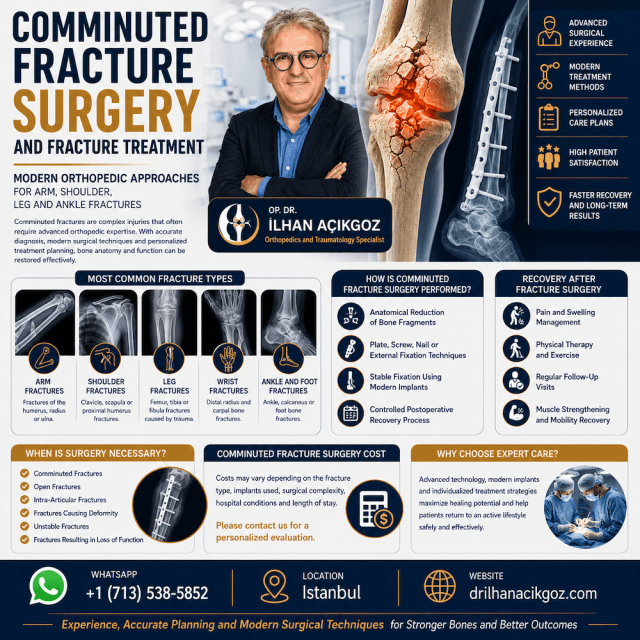
Not all fractures require surgery, but comminuted fractures frequently need operative treatment because the bone fragments cannot be adequately stabilized with a cast alone.
Surgery may be recommended when:
- The fracture is displaced
- Multiple bone fragments are present
- Joint surfaces are involved
- The fracture is unstable
- Significant deformity exists
- Conservative treatment is unlikely to succeed
What Is Comminuted Fracture Surgery?
The goal of surgery is to restore normal bone alignment and stability while allowing the bone to heal correctly.
Common surgical techniques include:
Plate and Screw Fixation
Specialized plates and screws are used to reconstruct and stabilize the fracture.
Intramedullary Nailing
A metal rod is inserted into the bone canal to maintain alignment and stability.
External Fixation
In severe trauma cases, an external frame may be temporarily or permanently used to stabilize the fracture.
Fragment Reconstruction
Complex fractures often require careful reconstruction of multiple bone fragments before fixation.
Recovery After Fracture Surgery
Recovery depends on:
- Patient age
- Bone quality
- Fracture severity
- Surgical technique
- Rehabilitation compliance
Treatment typically includes:
- Early mobilization
- Physical therapy
- Muscle strengthening
- Range-of-motion exercises
- Regular follow-up imaging
Most patients gradually regain function as healing progresses.
Potential Complications
Although modern orthopedic surgery is highly successful, complications can occasionally occur.
These include:
- Delayed union
- Nonunion
- Malunion
- Infection
- Joint stiffness
- Implant-related problems
- Post-traumatic arthritis
Early treatment and appropriate follow-up significantly reduce these risks.
Why Is Early Treatment Important?
Prompt evaluation and treatment can:
- Improve fracture alignment
- Reduce healing complications
- Preserve joint function
- Minimize long-term disability
- Accelerate recovery
Complex fractures are generally easier to manage when treated early by an experienced orthopedic trauma surgeon.
Evaluation by Op. Dr. İlhan AÇIKGÖZ
Op. Dr. İlhan AÇIKGÖZ provides comprehensive evaluation and treatment for complex fractures, comminuted fractures, orthopedic trauma, shoulder fractures, arm fractures, leg fractures and advanced reconstructive orthopedic procedures. Treatment plans are tailored to each patient’s injury pattern, functional goals and overall health condition.
Frequently Asked Questions
What is a comminuted fracture?
A comminuted fracture occurs when a bone breaks into three or more fragments.
Do all comminuted fractures require surgery?
No. However, many complex fractures require surgical stabilization because the bone fragments cannot maintain proper alignment on their own.
How long does fracture healing take?
Healing time varies depending on the injury, patient age and bone quality, but most fractures require several weeks to months for complete recovery.
Can comminuted fractures heal completely?
Yes. With appropriate treatment and rehabilitation, many patients achieve excellent recovery and return to normal activities.
What is the difference between a simple fracture and a comminuted fracture?
A simple fracture usually involves two bone fragments, whereas a comminuted fracture produces multiple fragments and is generally more complex to treat.
Conclusion
Comminuted fractures are among the most challenging orthopedic injuries and often require advanced surgical treatment. Early diagnosis, proper fracture stabilization and structured rehabilitation are essential for restoring function and achieving optimal long-term outcomes. Patients with shoulder, arm, leg or complex fractures should seek prompt evaluation by an experienced orthopedic specialist to ensure the best possible recovery.