
Patellar Instability: When Does a Dislocating Kneecap Require Treatment or Surgery?
The knee is one of the largest and most complex joints in the human body. Every step, jump, squat, and athletic movement places significant stress on the structures responsible for knee stability.
One of the most important structures involved in normal knee function is the patella, commonly known as the kneecap. When the patella moves out of its normal position, patients may experience pain, instability, loss of confidence while walking, and recurrent episodes of dislocation.
Patellar instability is particularly common among adolescents, young adults, and athletes. Without appropriate diagnosis and treatment, recurrent kneecap dislocations can lead to cartilage damage, chronic pain, and early joint degeneration.
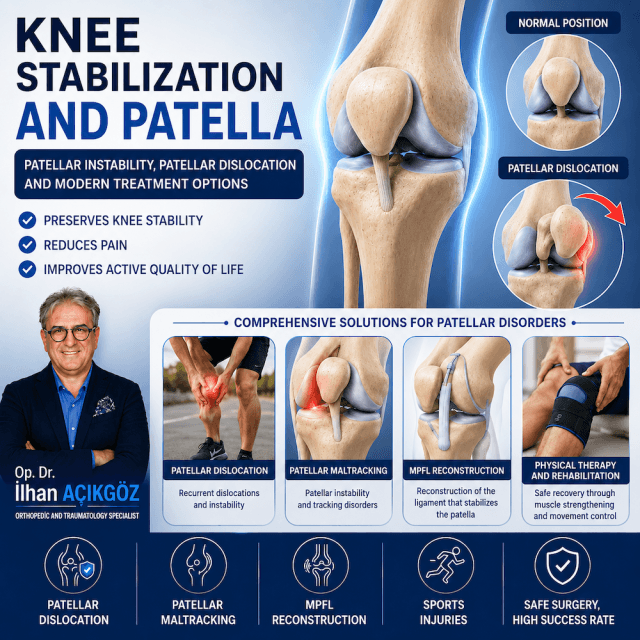
What Is the Patella?
The patella is a small bone located at the front of the knee joint. It sits within the quadriceps tendon and glides in a groove at the end of the femur during knee movement.
The kneecap acts as a mechanical pulley that improves the efficiency of the thigh muscles and helps stabilize knee motion.
Normal movement of the patella is essential for pain-free walking, running, climbing stairs, and sports activities.
What Is Patellar Instability?
Patellar instability occurs when the kneecap does not remain properly aligned within its groove during knee movement.
In some patients, the patella shifts partially out of place (subluxation). In more severe cases, the kneecap completely dislocates from the joint.
Patellar instability can develop after a traumatic injury or because of anatomical factors that predispose the kneecap to move abnormally.
What Causes Patellar Instability?
Several factors may contribute to kneecap instability, including:
- Previous patellar dislocation
- Sports injuries
- Ligament damage
- Shallow trochlear groove
- High-riding patella (patella alta)
- Malalignment of the lower extremity
- Generalized ligament laxity
- Muscle imbalance
- Connective tissue disorders
- Family history of kneecap instability
Many patients have a combination of structural and functional factors.
Symptoms of Patellar Instability
Symptoms may include:
- Pain at the front of the knee
- A feeling that the knee may “give way”
- Recurrent kneecap dislocations
- Popping or shifting sensations
- Swelling after activity
- Difficulty climbing stairs
- Pain during sports
- Reduced confidence while walking or running
Some patients report feeling that the kneecap “slips out and back in” during movement.
What Is a Patellar Dislocation?
A patellar dislocation occurs when the kneecap completely moves out of its normal position.
Most dislocations occur toward the outer side of the knee and are often associated with sports injuries, sudden twisting movements, or direct trauma.
A first-time dislocation may be extremely painful and often causes significant swelling.
What Happens After a First-Time Patellar Dislocation?
Not every patient requires surgery after a first-time dislocation.
Treatment depends on:
- Age
- Activity level
- Severity of injury
- Associated cartilage damage
- Ligament injury
- Anatomical risk factors
Some patients recover successfully with physiotherapy and rehabilitation, while others remain at high risk for recurrent instability.
Why Does the Kneecap Keep Dislocating?
Recurrent patellar dislocation often indicates an underlying anatomical problem.
Common causes include:
- MPFL injury
- Trochlear dysplasia
- Patella alta
- Malalignment of the leg
- Rotational abnormalities
- Generalized joint laxity
Repeated dislocations increase the risk of cartilage damage and early patellofemoral arthritis.
What Is MPFL Reconstruction?
The Medial Patellofemoral Ligament (MPFL) is the primary soft tissue restraint that prevents the kneecap from dislocating laterally.
When this ligament is torn, recurrent instability may occur.
MPFL reconstruction is a specialized surgical procedure that restores knee stability by reconstructing the damaged ligament using a graft.
This procedure has become one of the most effective treatments for recurrent patellar instability.
When Is Knee Stabilization Surgery Necessary?
Surgery may be recommended when:
- The kneecap repeatedly dislocates
- Conservative treatment fails
- Significant cartilage damage is present
- Structural abnormalities increase the risk of recurrence
- The patient wishes to return to sports
- Persistent instability affects daily life
The exact surgical technique depends on the underlying cause of instability.
Surgical Options for Patellar Instability
Modern treatment may include:
MPFL Reconstruction
Restores the primary stabilizing ligament.
Tibial Tubercle Osteotomy
Corrects abnormal patellar tracking.
Trochleoplasty
Improves the shape of the femoral groove in selected patients.
Cartilage Restoration Procedures
Addresses cartilage damage caused by repeated dislocations.
Many patients benefit from a combination of procedures tailored to their anatomy.
Recovery After Patellar Stabilization Surgery
Recovery varies depending on the procedure performed.
Most patients can expect:
- Early mobilization
- Structured physiotherapy
- Progressive strengthening exercises
- Gradual return to sports
Many individuals return to normal daily activities within several weeks and resume athletic activities after appropriate rehabilitation.
Can Patellar Instability Be Treated Without Surgery?
Yes.
Non-surgical treatment may include:
- Physical therapy
- Quadriceps strengthening
- Activity modification
- Knee bracing
- Neuromuscular training
However, recurrent instability often requires more definitive treatment.
Evaluation by Op. Dr. İlhan AÇIKGÖZ
Op. Dr. İlhan AÇIKGÖZ provides comprehensive evaluation and treatment for patellar instability, recurrent kneecap dislocation, sports-related knee injuries, and complex knee disorders. Treatment plans are individualized according to the patient’s anatomy, activity level, and long-term functional goals.
Advanced imaging, detailed biomechanical assessment, and modern knee stabilization techniques help optimize outcomes and support a safe return to daily activities and sports.
Frequently Asked Questions
Can a dislocated kneecap heal on its own?
A first-time dislocation may recover with conservative treatment, but recurrent instability requires specialist evaluation.
What is the most common surgery for recurrent patellar dislocation?
MPFL reconstruction is currently one of the most commonly performed and effective procedures.
Is patellar instability common in athletes?
Yes. Athletes, particularly those involved in pivoting sports, have a higher risk of kneecap instability.
Can recurrent kneecap dislocations cause arthritis?
Yes. Repeated dislocations can damage cartilage and increase the risk of patellofemoral osteoarthritis.
How long does recovery take after MPFL reconstruction?
Recovery varies, but many patients return to sports within several months following structured rehabilitation.
Conclusion
Patellar instability is more than a temporary knee problem. Recurrent kneecap dislocations can lead to cartilage damage, chronic pain, reduced athletic performance, and long-term joint degeneration. Early diagnosis and individualized treatment are essential for restoring stability, protecting knee function, and preventing future complications.