What Is Hip Replacement Revision Surgery?
Hip replacement surgery is one of the most successful orthopedic procedures for relieving pain and restoring mobility in patients with severe hip arthritis, joint damage, or deformities. Modern hip implants can provide excellent long-term results and significantly improve quality of life.
However, some patients may develop complications months or even years after surgery. When a previously implanted hip prosthesis requires partial or complete replacement, the procedure is called hip replacement revision surgery.
Revision procedures are more complex than primary hip replacement surgeries and require careful planning, specialized implants, and extensive surgical expertise.
Why Do Hip Replacements Fail?
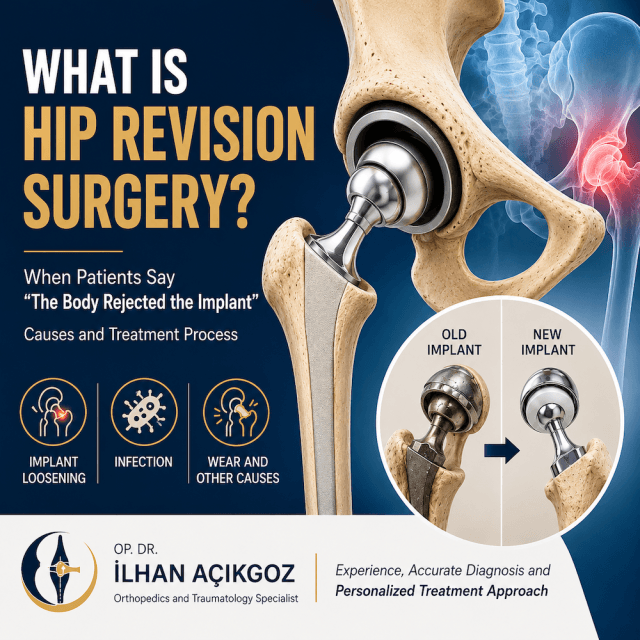
Many patients describe implant-related complications by saying, “My body rejected the hip replacement.”
In reality, true biological rejection is extremely rare. Most problems result from mechanical, infectious, or structural issues affecting the implant.
Common causes include:
- Implant loosening
- Hip replacement infection
- Recurrent hip dislocation
- Implant wear
- Bone loss around the implant
- Periprosthetic fracture
- Component malposition
- Soft tissue instability
Identifying the exact cause is essential for determining the appropriate treatment strategy.
What Is Hip Implant Loosening?
Hip implant loosening occurs when the prosthesis gradually loses its stable connection to the surrounding bone.
Patients may experience:
- Groin pain
- Thigh pain
- Hip pain during walking
- Difficulty bearing weight
- Reduced mobility
- A feeling of instability
Loosening may develop slowly over many years or occur earlier because of infection, poor bone quality, trauma, or excessive implant wear.
Symptoms of a Failed Hip Replacement
Signs that a hip replacement may not be functioning properly include:
- Persistent hip pain
- Pain that develops after years of successful function
- Limping
- Difficulty walking
- Leg length changes
- Hip instability
- Recurrent dislocations
- Swelling around the joint
- Reduced range of motion
These symptoms should always be evaluated by an orthopedic specialist.
Hip Replacement Infection
One of the most serious complications after hip replacement surgery is infection.
A hip replacement infection may occur:
- Shortly after surgery
- Months later
- Years after implantation
In some cases, bacteria from another infection elsewhere in the body can travel through the bloodstream and infect the prosthetic joint.
Symptoms of Hip Replacement Infection
Patients may experience:
- Persistent pain
- Swelling
- Warmth around the joint
- Redness
- Drainage from the surgical site
- Difficulty walking
- Fatigue
Importantly, fever is not always present.
Why Does a Hip Replacement Dislocate?
Hip replacement dislocation occurs when the prosthetic femoral head comes out of the artificial socket.
Dislocations may result from:
- Trauma or falls
- Component malposition
- Muscle weakness
- Soft tissue imbalance
- Implant wear
- Previous revision surgeries
Hip dislocation requires prompt orthopedic evaluation.
Recurrent Hip Dislocation
When a hip replacement repeatedly dislocates, it usually indicates a more significant mechanical problem.
Possible causes include:
- Malpositioned components
- Implant loosening
- Soft tissue insufficiency
- Spinopelvic imbalance
- Bone loss
- Previous surgical complications
Repeated dislocations often require revision surgery rather than simple relocation procedures.
When Is Hip Replacement Revision Necessary?
Revision hip surgery may be recommended for:
- Implant loosening
- Infection
- Implant wear
- Recurrent dislocation
- Periprosthetic fractures
- Bone loss
- Mechanical failure
- Severe pain and functional limitations
Early evaluation can prevent more extensive bone damage and improve surgical outcomes.
How Is a Failed Hip Replacement Diagnosed?
A comprehensive evaluation may include:
- Physical examination
- X-rays
- CT scans
- Blood tests
- Joint aspiration
- Advanced imaging studies
Accurate diagnosis helps distinguish infection from mechanical loosening and guides treatment planning.
What Happens During Revision Hip Surgery?
Revision hip replacement surgery involves replacing part or all of the existing prosthesis.
The procedure may include:
- Removal of loose components
- Treatment of infection
- Reconstruction of bone defects
- Restoration of hip stability
- Implantation of specialized revision components
Each revision procedure is customized according to the patient’s anatomy and underlying problem.
Is It Always Necessary to Remove the Entire Implant?
Not necessarily.
Treatment depends on:
- The cause of failure
- Presence of infection
- Implant stability
- Bone quality
- Overall patient health
Some patients require only partial component exchange, while others may need complete revision reconstruction.
Evaluation by Op. Dr. İlhan AÇIKGÖZ
Op. Dr. İlhan AÇIKGÖZ provides advanced evaluation and treatment for complex hip conditions, including implant loosening, hip replacement infection, recurrent dislocation, and revision hip replacement surgery. Through comprehensive diagnostic assessment and individualized treatment planning, patients receive solutions designed to restore mobility, stability, and long-term joint function.
Frequently Asked Questions
How long do hip replacements last?
Modern hip replacements can often function successfully for 15 years or longer, although longevity varies between patients.
Can a loose hip implant heal on its own?
No. Implant loosening does not resolve spontaneously and requires orthopedic evaluation.
Can hip replacement infections be treated with antibiotics alone?
Some early infections may respond to antibiotics and surgical cleaning, but many cases require additional procedures or revision surgery.
What causes repeated hip dislocations after replacement surgery?
Common causes include implant malposition, soft tissue weakness, loosening, and mechanical instability.
Is revision hip surgery more difficult than the first hip replacement?
Yes. Revision procedures are generally more complex and require specialized surgical expertise.
Conclusion
Hip replacement surgery provides excellent long-term outcomes for most patients. However, implant loosening, infection, recurrent dislocation, and mechanical failure can occasionally occur. Early diagnosis and appropriate treatment are essential for preserving mobility and achieving successful long-term results. Patients experiencing persistent pain, instability, or changes in hip function should seek prompt orthopedic evaluation.